Custom AI agents
Custom AI agents.
Controlled business workflows.
Custom AI agents can coordinate multi-step work through approved tools, with explicit permissions, review checkpoints and a record of what happened.
Find your AI opportunity ↗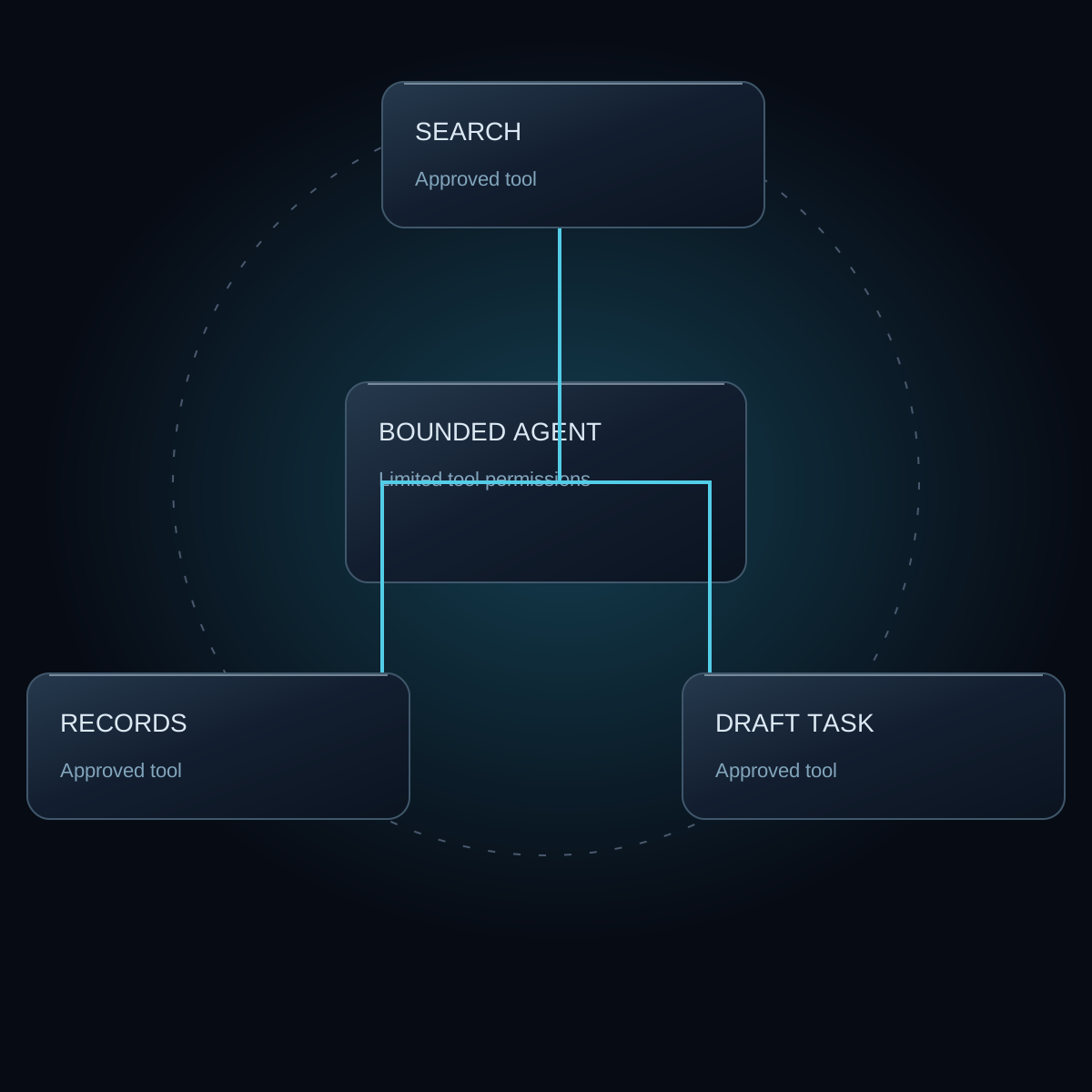
01 / THE BUSINESS NEED
Built around how your business works.
Traditional automation follows predetermined rules. An AI-assisted workflow uses a model to interpret information within that process. An agent can choose among allowed steps or tools to pursue a defined task. That additional flexibility requires stronger boundaries, not fewer controls.
We design agents around specific business responsibilities. Each tool has a limited purpose, input validation and a clear authorization check. An agent should not gain broader database or communication permissions simply because it can describe a useful next action.
02 / A PRACTICAL EXAMPLE
See the workflow.
Understand the possibility.
A fictional internal research workflow might locate approved documents, retrieve related customer records and prepare a briefing for an employee. The agent can coordinate the retrieval, but it cannot email the briefing externally or modify a customer account without separate authorization.
A more operational workflow could prepare a task after checking several systems. The application would enforce step limits, show supporting evidence and pause for approval before consequential actions. The goal is controlled assistance within real software, not an unbounded autonomous employee.
Illustrative scenario. No live customer data or automated action.
- 01Defined business task
- 02Allowed tool selection
- 03Bounded execution
- 04Approval checkpoint
- 05Logged outcome
03 / CONNECTED TO YOUR BUSINESS
The systems behind
the experience.
The integration plan depends on your existing tools, data access and business rules. These are common connection categories to explore:
- Read-limited database and search adapters
- Approved business APIs
- Task preparation and review queues
- Monitoring and audit services
We verify available APIs, permissions and ownership before committing to an integration. We have not inspected your systems through this website.
04 / ENGINEERED FOR REAL USE
From a useful idea
to dependable software.
Start by defining the permitted actions and explicit exclusions. Test whether a deterministic workflow would be sufficient before adding agentic choice. Where flexibility is useful, set limits on steps, runtime and resource use.
Evaluation needs adversarial and failure cases: misleading documents, unavailable tools, partial results and repeated requests. The application should stop safely when it cannot complete a task. Monitor tool calls and preserve enough evidence to understand an error without keeping unnecessary sensitive payloads.
Security and privacy in the design
Treat tool permissions as application security controls. Validate every proposed operation on the server and do not trust model output as authorization. Untrusted documents must not override system instructions. External messages, destructive operations and sensitive changes need the agreed human approval boundary.
QUESTIONS WORTH ASKING
How is an agent different from a chatbot?
A chatbot primarily exchanges messages. An agent may coordinate allowed tools and steps. The distinction matters because tool access can affect real systems.
Can an agent run without supervision?
Some bounded, low-risk tasks may be designed for unattended execution. Consequential actions require explicit controls, monitoring and a reviewed failure policy.
Can we start with a simpler workflow?
Yes. Rules-based automation or an AI-assisted review queue may provide the needed value with less complexity. We choose the architecture around the task.
A CLEAR NEXT STEP
Your process.
A practical starting point.
Use the AI Opportunity Studio to frame your business challenge, explore possible workflows and prepare a useful brief. Your assessment is available before you share contact details.
Explore your AI opportunity ↗Connected capabilities.
Practical reading.
Clear review boundaries matter wherever generated information meets a real business workflow.