
AI business automation
AI business automation.
More intelligent operations.
AI business automation helps turn unstructured information into reviewable work: categorized requests, extracted fields, prepared tasks and approved follow-up.
Find your AI opportunity ↗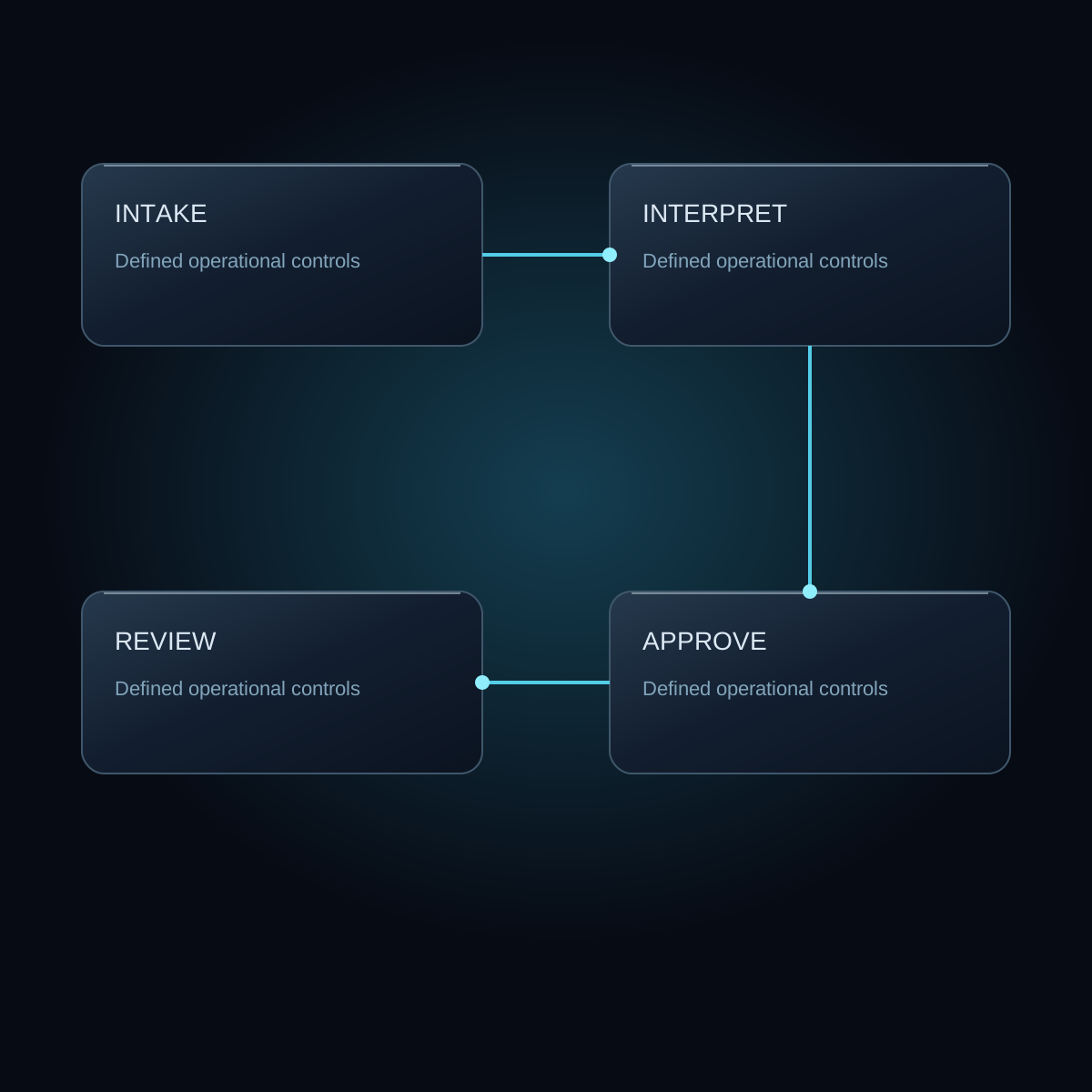
01 / THE BUSINESS NEED
Built around how your business works.
Many business processes stall before a record is ready for the next system. Someone reads an email, interprets a document, decides which team owns it and retypes the details. AI can assist with that interpretation, while conventional rules control what happens after it.
We separate a suggestion from an action. The automation should show what it understood, where the information came from and which details still need confirmation. This makes it possible to reduce repetitive handling without hiding uncertainty from the people responsible for the work.
02 / A PRACTICAL EXAMPLE
See the workflow.
Understand the possibility.
A fictional operations team receives requests through several channels. A workflow could categorize each request, identify missing details and prepare an assigned task. Routine items follow documented routing rules; unusual items enter a review queue. A manager can see the outstanding work and who owns each next step.
The same pattern can support document extraction, follow-up preparation, appointment coordination and management reporting. The value comes from connecting the interpretation to an operational process, with deliberate controls around consequential changes. We would agree how to measure the resulting workflow rather than promise a percentage improvement.
Illustrative scenario. No live customer data or automated action.
- 01Incoming information
- 02Interpret + classify
- 03Prepare structured work
- 04Review exceptions
- 05Approved action
03 / CONNECTED TO YOUR BUSINESS
The systems behind
the experience.
The integration plan depends on your existing tools, data access and business rules. These are common connection categories to explore:
- Email, document and form intake
- Existing customer and operations databases
- Task, scheduling and reporting systems
- Notification services with approval controls
We verify available APIs, permissions and ownership before committing to an integration. We have not inspected your systems through this website.
04 / ENGINEERED FOR REAL USE
From a useful idea
to dependable software.
Begin with a process map that includes exceptions, duplicate requests and missing data. Define what can happen automatically, what requires review and what must never be inferred. A pilot should include hard examples, not just the cleanest documents.
Automation needs a durable history and a safe way to recover. We design duplicate protection, bounded retries and queues that retain work when a downstream system fails. Reporting should distinguish received, prepared, approved and completed items so a temporary error cannot look like success.
Security and privacy in the design
Keep approval authority explicit. Sensitive outputs, external messages and financial or operational changes may need stronger review than internal categorization. Limit service-account permissions, record approved actions and avoid copying entire source documents into every log.
QUESTIONS WORTH ASKING
Is AI always required for automation?
No. If inputs and decisions are predictable, ordinary rules may be simpler and more reliable. AI is useful where interpreting language or documents is part of the problem.
Can staff approve work before it is sent?
Yes. Review queues and approval controls are core design options. We define the appropriate boundary for each action.
How do we know whether a pilot works?
Agree on representative examples and measurable acceptance criteria, such as correct routing, time spent reviewing and handling of exceptions. Results must be measured on your workflow.
A CLEAR NEXT STEP
Your process.
A practical starting point.
Use the AI Opportunity Studio to frame your business challenge, explore possible workflows and prepare a useful brief. Your assessment is available before you share contact details.
Explore your AI opportunity ↗Connected capabilities.
Practical reading.
Clear review boundaries matter wherever generated information meets a real business workflow.