
Custom AI call intelligence
Custom AI call intelligence.
A clear next step.
Custom AI call intelligence connects recorded conversations to business workflows: transcription, summaries, categories and prepared actions your team can review.
Find your AI opportunity ↗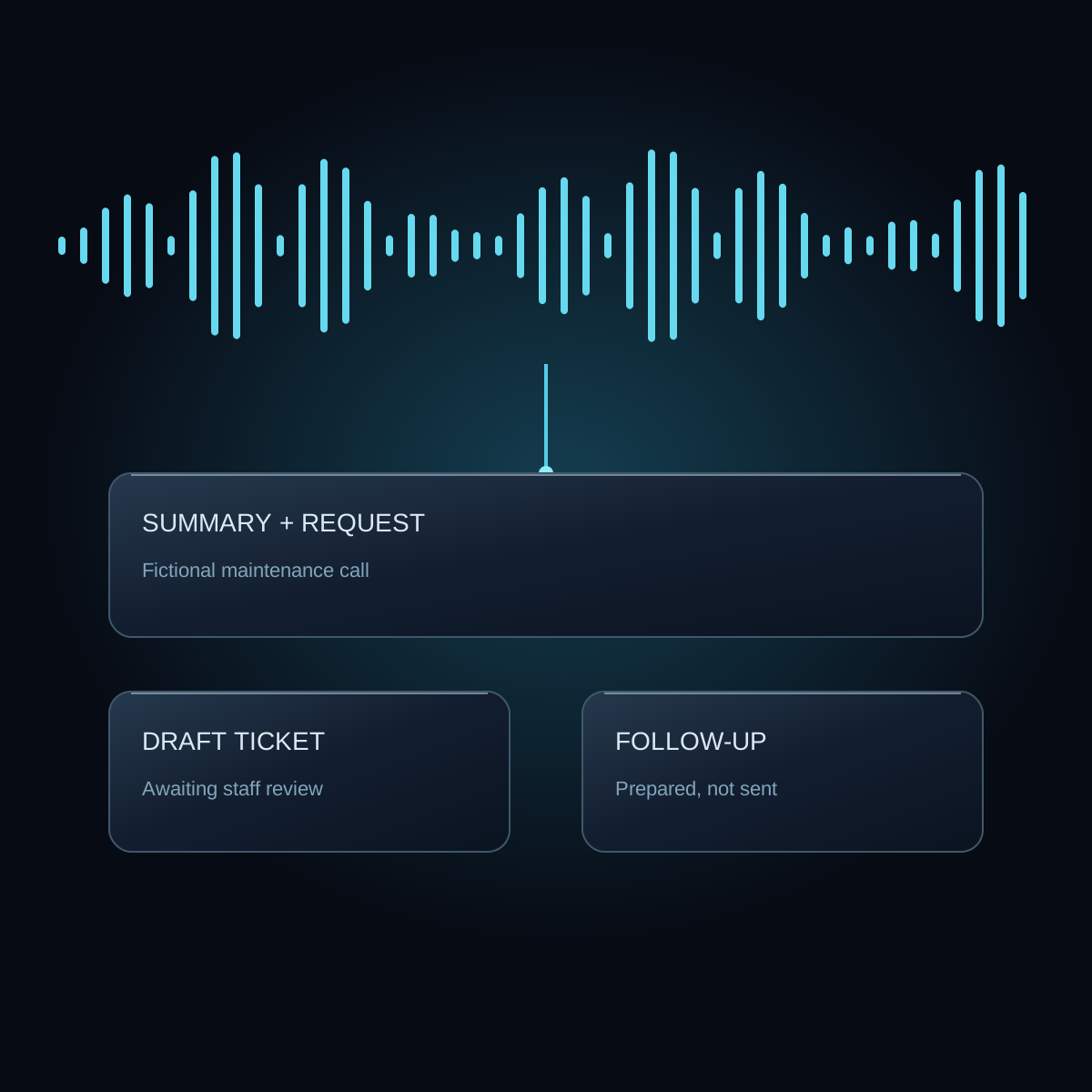
01 / THE BUSINESS NEED
Built around how your business works.
A transcript is useful, but it is rarely the end of the job. Staff still need to identify the customer, understand the request, connect it to the right record and decide what to do next. We build the application that carries a recorded WAV or MP3 conversation through those steps.
The process should preserve access to the source recording and distinguish extracted facts from uncertain interpretations. Names, addresses, dates and numbers need careful handling. When the match is unclear, the system should ask for review rather than silently attach the request to the wrong customer.
02 / A PRACTICAL EXAMPLE
See the workflow.
Understand the possibility.
PropertyMax-inspired concept � fictional scenario: a tenant calls about a broken air conditioner. The system transcribes the recording, suggests the tenant and property match, summarizes the issue and classifies it as maintenance. It prepares a draft ticket and follow-up text for staff review.
Once a person confirms the details and approves the action, the connected application can record the work in a management dashboard. This illustration describes a possible workflow. It does not assert that every depicted PropertyMax capability is currently deployed, and no live ticket or SMS is created by this page.
Illustrative scenario. No live customer data or automated action.
- 01Recorded call
- 02Transcript + summary
- 03Draft maintenance request
- 04Staff review
- 05Approved follow-up
03 / CONNECTED TO YOUR BUSINESS
The systems behind
the experience.
The integration plan depends on your existing tools, data access and business rules. These are common connection categories to explore:
- Recorded WAV and MP3 ingestion
- Customer, tenant and property records
- Maintenance, CRM and task systems
- Approved notification and reporting channels
We verify available APIs, permissions and ownership before committing to an integration. We have not inspected your systems through this website.
04 / ENGINEERED FOR REAL USE
From a useful idea
to dependable software.
We define how recordings arrive, how duplicates are recognized and which records may be searched. A useful pilot includes background noise, incomplete requests, multiple speakers and ambiguous names. Evaluate the final structured task as well as the transcript.
Durable processing should show whether a recording is waiting, transcribed, reviewed or completed. A failed transcription must remain visible for recovery. Downstream tasks and notifications need independent status so a successful summary cannot be mistaken for an action already taken.
Security and privacy in the design
Agree on authorized recording sources, access, retention and appropriate notices before implementation. Restrict recordings and transcripts to the staff who need them. Do not use an extracted name as sufficient identity verification, and keep consequential follow-up behind the agreed approval boundary.
QUESTIONS WORTH ASKING
Does this answer live telephone calls?
This service example focuses on processing recorded WAV and MP3 calls. A live voice agent is a different scope with additional latency, telephony and operational requirements.
Can it automatically identify a customer?
It can suggest a match from approved records. Ambiguous or incomplete matches should be reviewed rather than treated as verified identity.
Will messages be sent automatically?
The illustrated workflow prepares follow-up for approval. Any automatic sending would require a separately defined permission and business rule.
A CLEAR NEXT STEP
Your process.
A practical starting point.
Use the AI Opportunity Studio to frame your business challenge, explore possible workflows and prepare a useful brief. Your assessment is available before you share contact details.
Explore your AI opportunity ↗Connected capabilities.
Practical reading.
Clear review boundaries matter wherever generated information meets a real business workflow.