AI CRM development
AI CRM development.
Better intelligence.
AI CRM development connects customer records, communication history and next-step suggestions in a system built around your relationship workflow.
Find your AI opportunity ↗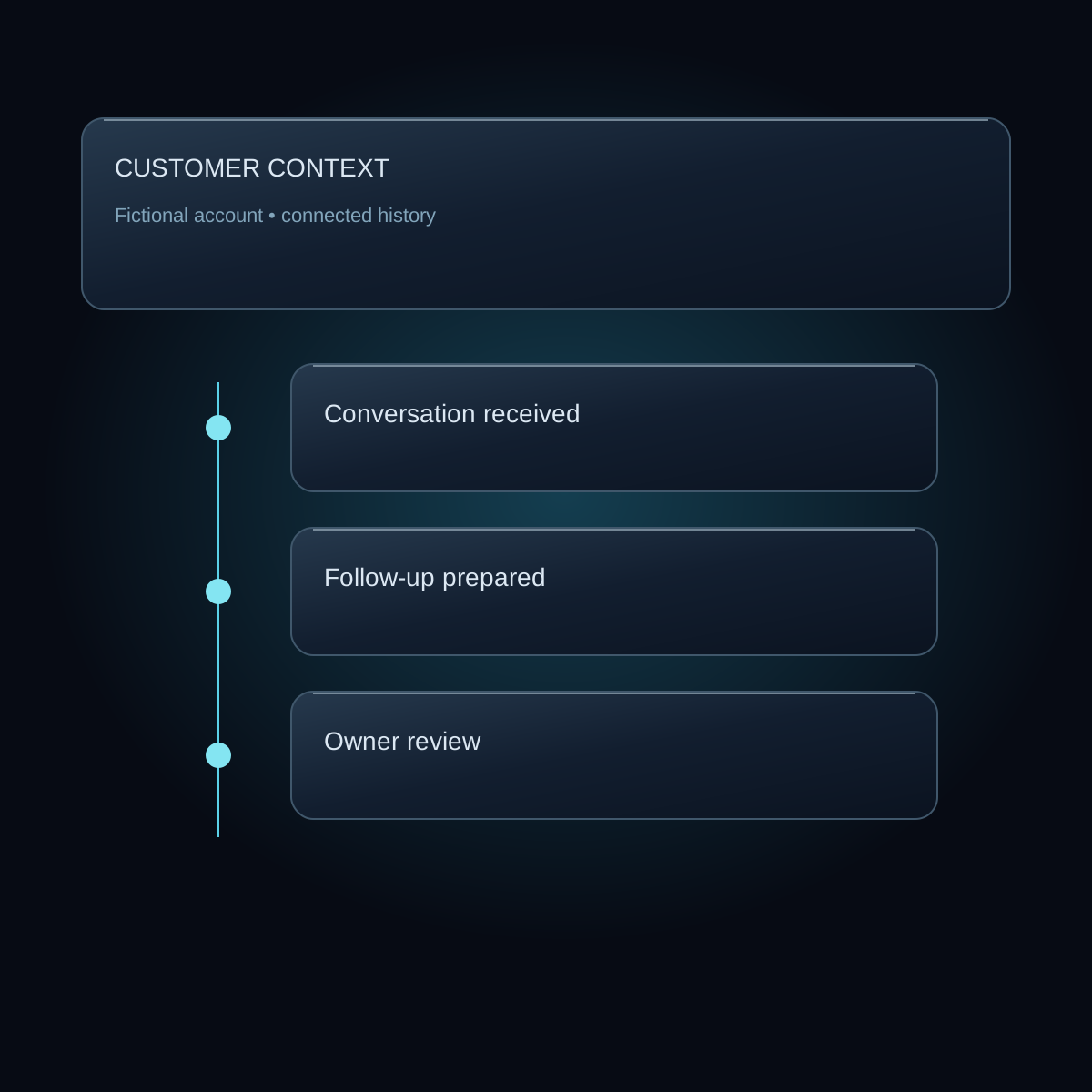
01 / THE BUSINESS NEED
Built around how your business works.
A CRM is only useful when it reflects how your team qualifies, serves and follows up with customers. Adding AI to disconnected or inaccurate records can make the wrong information more persuasive. We start with the customer model, ownership rules and reliable communication history.
Intelligence can then help summarize a relationship, identify a request and prepare a follow-up task. The system should show why a suggestion was made and allow the person responsible to correct it. Approved record updates remain distinct from generated interpretations.
02 / A PRACTICAL EXAMPLE
See the workflow.
Understand the possibility.
For a fictional project-based business, the customer workspace could combine inquiry details, prior conversations, open tasks and a proposal status. A new email might trigger a suggested next step, with the supporting message beside it. The account owner decides whether the suggestion belongs in the customer record.
Managers could review workload and follow-up coverage using defined reporting rules. AI assistance can make context easier to find, but it should not invent customer intent, predict outcomes as facts or make consequential decisions about people without an appropriate process.
Illustrative scenario. No live customer data or automated action.
- 01Customer activity
- 02Unified history
- 03Suggested next step
- 04Account owner review
- 05Approved CRM update
03 / CONNECTED TO YOUR BUSINESS
The systems behind
the experience.
The integration plan depends on your existing tools, data access and business rules. These are common connection categories to explore:
- Customer databases and existing CRM exports
- Email and recorded conversation systems
- Scheduling, quoting and accounting tools
- Reporting and permission-aware search
We verify available APIs, permissions and ownership before committing to an integration. We have not inspected your systems through this website.
04 / ENGINEERED FOR REAL USE
From a useful idea
to dependable software.
We map relationship stages, ownership and required fields before designing automation. Data migration needs duplicate rules and a clear source of truth. A pilot should include incomplete histories and conflicting information, not only well-maintained accounts.
The CRM should support everyday actions quickly. Search, task assignment, notes and reporting need to work independently of model availability. We also define how generated summaries are refreshed when source information changes, and how staff can trace an interpretation back to the record that supports it.
Security and privacy in the design
Protect customer contact information with role and record-level permissions. Limit exports and model context to authorized purposes. Define retention and correction procedures so outdated generated summaries do not survive after the underlying information is corrected.
QUESTIONS WORTH ASKING
Do we have to replace our current CRM?
Not always. A focused integration may solve the problem. Custom CRM development is appropriate when the business model or workflows justify a dedicated system.
Can AI update customer records?
It can prepare proposed updates. The application should validate the fields and apply the agreed review rules before changing the system of record.
Can it help with lead qualification?
It can organize inquiry information against explicit business criteria. We avoid presenting uncertain inferences as verified facts or guaranteed purchase intent.
A CLEAR NEXT STEP
Your process.
A practical starting point.
Use the AI Opportunity Studio to frame your business challenge, explore possible workflows and prepare a useful brief. Your assessment is available before you share contact details.
Explore your AI opportunity ↗Connected capabilities.
Practical reading.
Clear review boundaries matter wherever generated information meets a real business workflow.