
AI integration services
AI integration services.
A new level of intelligence.
AI integration services connect useful intelligence to the websites, databases and business applications your team already relies on.
Find your AI opportunity ↗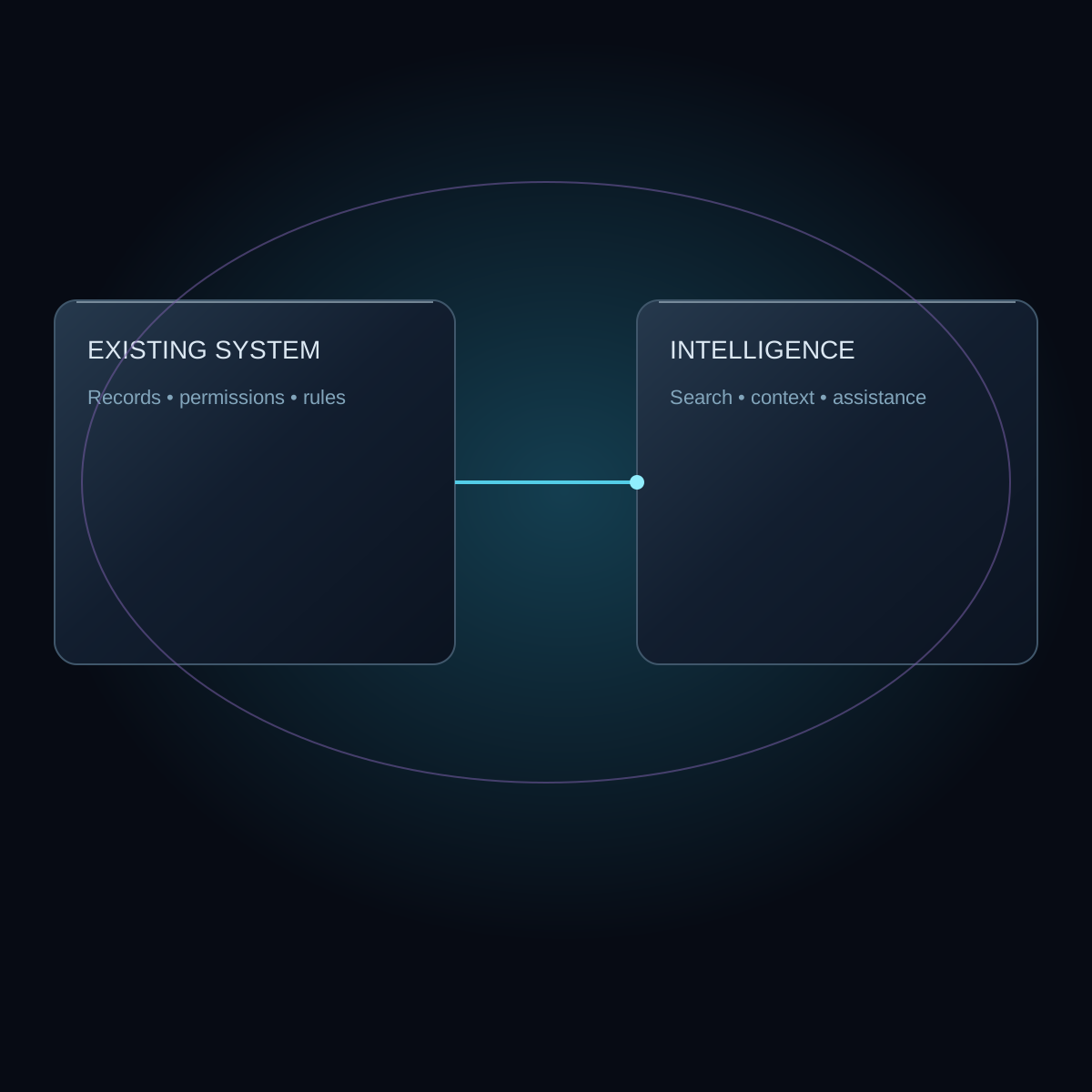
01 / THE BUSINESS NEED
Built around how your business works.
A working application contains more than screens. It holds years of customer information, permissions, validation and operational knowledge. Replacing it solely to introduce an AI feature can discard that value. We look first for a controlled integration point that preserves the system of record.
The starting question is specific: should the system help a visitor find information, qualify a request, interpret a document or prepare a staff action? That question determines what data the AI needs and which existing business rules must continue to apply. An integration should make the current workflow clearer, including what happens when a model cannot provide a reliable answer.
02 / A PRACTICAL EXAMPLE
See the workflow.
Understand the possibility.
In a fictional customer portal, a visitor asks about an order and the next available appointment. A permission-aware integration could retrieve only that customer�s records, explain the current status and prepare a scheduling request. It would not guess availability or modify an account based solely on generated text.
Other useful starting points include intelligent site search, staff knowledge search, inquiry qualification and document interpretation. Each requires a connection to dependable source information. A chatbot is one possible interface; a review panel inside an existing application may be a better fit for the task.
Illustrative scenario. No live customer data or automated action.
- 01Existing application
- 02Authorized records
- 03Intelligent assistance
- 04Validation + review
- 05Existing workflow
03 / CONNECTED TO YOUR BUSINESS
The systems behind
the experience.
The integration plan depends on your existing tools, data access and business rules. These are common connection categories to explore:
- Documented application APIs and webhooks
- Permission-aware database access
- CRM and customer account platforms
- Search indexes and knowledge repositories
We verify available APIs, permissions and ownership before committing to an integration. We have not inspected your systems through this website.
04 / ENGINEERED FOR REAL USE
From a useful idea
to dependable software.
We inspect the integration methods available before proposing a design. APIs, export formats, rate limits and vendor permissions can determine what is feasible. Where an API is absent, a controlled import or adapter may be appropriate; direct writes to another product�s database need particular care and ownership agreement.
Release the integration behind a bounded workflow, validate it with representative cases and preserve a usable fallback. A feature should not make the main application unavailable when an external model is slow. Timeouts, retries and clear staff escalation are part of the integration, not optional finishing touches.
Security and privacy in the design
Reuse the application�s authorization rules and verify them at every retrieval and write boundary. Treat website content and documents as untrusted inputs, not instructions that can expand tool permissions. Keep customer-facing output separate from administrative commands.
QUESTIONS WORTH ASKING
Will our website need a complete rebuild?
Not necessarily. Discovery identifies whether the current architecture supports the required integration. A focused addition may be sufficient; sometimes a limited modernization step is needed first.
Can AI read our database?
It can be connected through an application layer that limits access to approved records and operations. We do not recommend giving a model unrestricted access to a business database.
What if the external AI provider is unavailable?
Define a fallback such as conventional search, a saved request or a staff queue. The appropriate behavior depends on the importance of the underlying task.
A CLEAR NEXT STEP
Your process.
A practical starting point.
Use the AI Opportunity Studio to frame your business challenge, explore possible workflows and prepare a useful brief. Your assessment is available before you share contact details.
Explore your AI opportunity ↗Connected capabilities.
Practical reading.
Clear review boundaries matter wherever generated information meets a real business workflow.