Custom AI software development
Custom AI software development.
Built for the way you work.
Custom AI software development turns a business process into a complete application: the records, interfaces, integrations and review controls that make AI useful in everyday work.
Find your AI opportunity ↗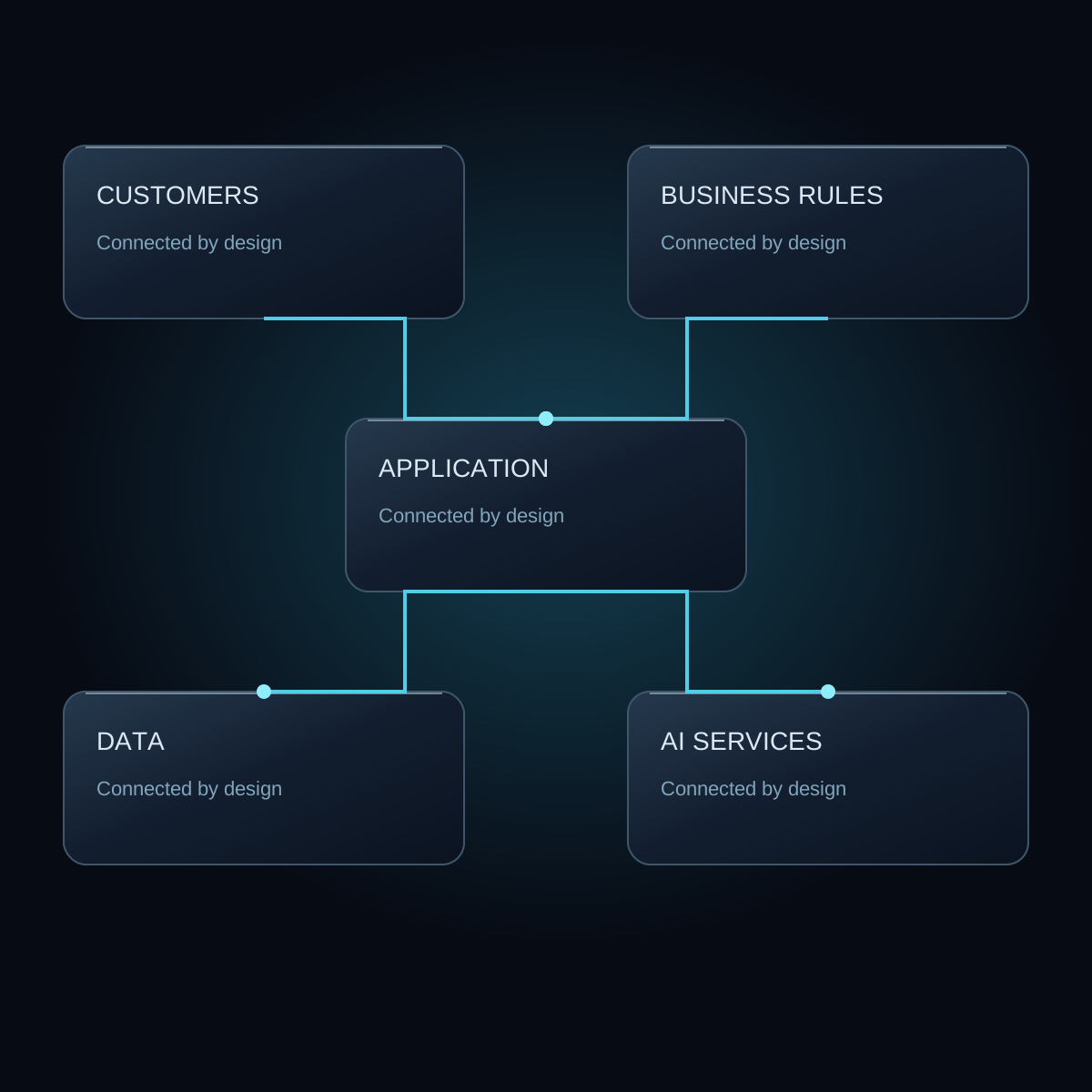
01 / THE BUSINESS NEED
Built around how your business works.
When a team moves between disconnected spreadsheets, customer records and communication tools, adding another AI window can create more work. The opportunity is to design the whole application around how information arrives, who makes decisions and what needs to happen next. We begin with those operational questions before selecting a model.
A useful application needs dependable behavior around the AI: sign-in, permissions, validation, search, reporting, error recovery and a clear way to correct mistakes. We bring 30+ years of software engineering experience to that foundation. The model is one component of a working system, with defined responsibilities and limits.
02 / A PRACTICAL EXAMPLE
See the workflow.
Understand the possibility.
Consider a fictional service company whose customer requests arrive by email, phone and a website form. Staff re-enter the same information in several systems and manually chase the next step. A custom application could assemble the request, suggest a category, prepare a task and put the supporting evidence in front of the right employee.
The employee confirms the customer and reviews the proposed action. Approved changes then reach the business database, with a history of what happened and a queue for exceptions. The same architecture can support AI dashboards, internal intelligence tools, document processing or an industry-specific customer application. This is a conceptual example, not a claim about a deployed client project.
Illustrative scenario. No live customer data or automated action.
- 01Business process
- 02Connected information
- 03AI-assisted application
- 04Human review
- 05Approved business action
03 / CONNECTED TO YOUR BUSINESS
The systems behind
the experience.
The integration plan depends on your existing tools, data access and business rules. These are common connection categories to explore:
- Business databases and existing records
- CRM, accounting and scheduling APIs
- Document stores, email and recorded calls
- Commercial or privately hosted AI models
We verify available APIs, permissions and ownership before committing to an integration. We have not inspected your systems through this website.
04 / ENGINEERED FOR REAL USE
From a useful idea
to dependable software.
We define the users, data model and acceptance criteria together. A working prototype should test a meaningful workflow with representative examples, including ambiguous inputs and failure cases. The next stage adds the operational controls needed for real use: permissions, monitoring, backups and a release plan.
An AI feature should earn its place. Deterministic rules are often more appropriate for fixed calculations or eligibility conditions. We use evaluation examples to decide where AI adds value and where conventional application code should remain in charge. Ownership, source-code handover, infrastructure responsibilities and ongoing support belong in the project agreement.
Security and privacy in the design
Access should follow business roles across both the application and its AI retrieval layer. A user must not gain access to restricted records simply by asking a model. We map where data travels, limit model context to what is needed, and design logging so it supports investigation without unnecessarily copying sensitive information.
QUESTIONS WORTH ASKING
Do we need to choose an AI model first?
No. Begin with the process, data boundaries and quality requirements. Model selection follows evaluation against those needs, including cost and operational constraints.
Can you build the application as well as the AI feature?
Yes. Our focus is the complete business application, including its database, interfaces, integrations and deployment. The specific scope is established during discovery.
What should we bring to a first conversation?
A description of one workflow, the systems involved, the exceptions that cause difficulty and the outcome you want. Avoid sending confidential records before agreeing on a secure discovery process.
A CLEAR NEXT STEP
Your process.
A practical starting point.
Use the AI Opportunity Studio to frame your business challenge, explore possible workflows and prepare a useful brief. Your assessment is available before you share contact details.
Explore your AI opportunity ↗Connected capabilities.
Practical reading.
Clear review boundaries matter wherever generated information meets a real business workflow.