Private AI development
Private AI development.
On your terms.
Private AI development gives your business choices about where models run, how information is handled and who operates the infrastructure.
Find your AI opportunity ↗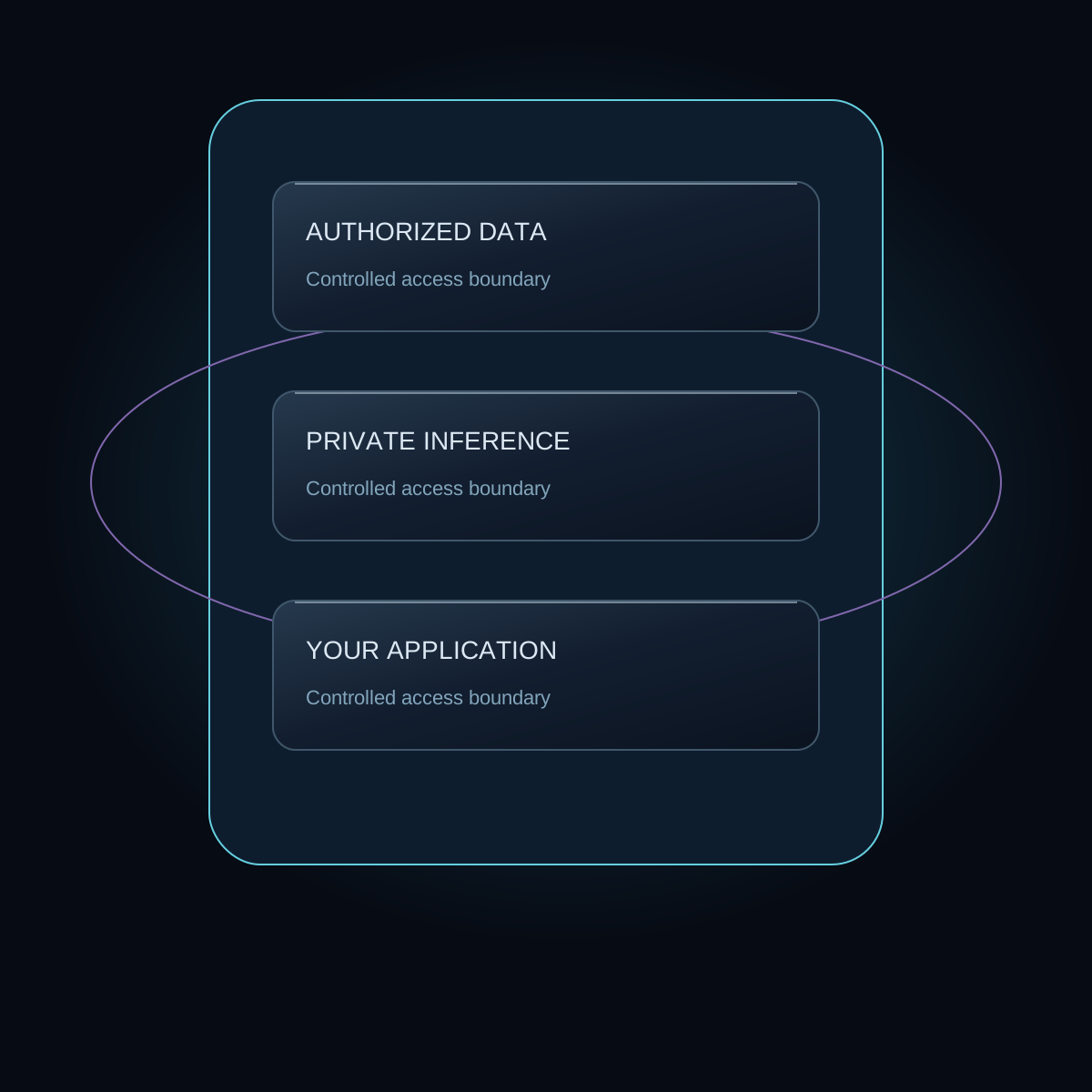
01 / THE BUSINESS NEED
Built around how your business works.
An external API is not the only way to use AI. Privately hosted open-source models can run on dedicated infrastructure, on premises or within a controlled cloud environment. A hybrid design can keep selected records within one boundary while using external models for approved tasks.
Those choices introduce tradeoffs. Private hosting is not automatically more secure, faster or less expensive. Model quality, hardware utilization, patching, access controls, availability and staff responsibility all affect the result. The useful comparison is the entire application and its operating requirements, not just a per-request price.
02 / A PRACTICAL EXAMPLE
See the workflow.
Understand the possibility.
Imagine a fictional internal knowledge tool that helps staff find information in an approved document library. A private architecture could keep the index, retrieval layer and inference service under one operational boundary. Users would still need permission checks, source citations and a way to report a wrong answer.
A hybrid alternative might use a private model for sensitive document classification and a commercial model for approved public-facing copy. The data-flow design should make those choices explicit. Model deployment alone does not create the surrounding software or a reliable business workflow.
Illustrative scenario. No live customer data or automated action.
- 01Approved business data
- 02Access-controlled retrieval
- 03Private / cloud / hybrid model
- 04Review + validation
- 05Business application
03 / CONNECTED TO YOUR BUSINESS
The systems behind
the experience.
The integration plan depends on your existing tools, data access and business rules. These are common connection categories to explore:
- Dedicated inference servers and approved model runtimes
- Internal databases and document libraries
- Application authentication and role systems
- Monitoring, backup and deployment tooling
We verify available APIs, permissions and ownership before committing to an integration. We have not inspected your systems through this website.
04 / ENGINEERED FOR REAL USE
From a useful idea
to dependable software.
We start with the workload, data boundaries and quality criteria. Test representative prompts and documents against candidate models, then size the infrastructure for expected concurrency and latency. Hardware planning should consider both routine use and peak demand.
Operations matter after installation. Assign responsibility for updates, model changes, monitoring and incident response. Establish a rollback path when a new model behaves differently. Compare infrastructure and staffing costs with cloud alternatives before committing to a deployment architecture.
Security and privacy in the design
Control access to the model endpoint as carefully as access to the application. Network location alone is not authorization. Review document permissions, retention, backups and logs, and confirm where any embedding, transcription or supporting service processes information.
QUESTIONS WORTH ASKING
Does private mean everything stays on our premises?
Only if the agreed architecture places all relevant processing there. Dedicated cloud and hybrid deployments have different data paths, which should be documented explicitly.
Is private AI cheaper than an API?
It depends on workload, hardware, staffing and model quality needs. Light or irregular use may favor an API; sustained workloads may justify private infrastructure. Discovery should compare total operating requirements.
Can we change models later?
An adapter-based application can make replacement easier, but model behavior and output quality still need reevaluation. Changing a model is an application change with acceptance checks.
A CLEAR NEXT STEP
Your process.
A practical starting point.
Use the AI Opportunity Studio to frame your business challenge, explore possible workflows and prepare a useful brief. Your assessment is available before you share contact details.
Explore your AI opportunity ↗Connected capabilities.
Practical reading.
Clear review boundaries matter wherever generated information meets a real business workflow.